To practice mindful studying, start by finding a quiet space and sitting comfortably with your feet grounded and spine straight. Take deep breaths (4 counts in, 6 counts out) to center yourself, then scan your body from toes to head while releasing tension. Clear your study area of distractions and maintain a comfortable room temperature between 68-72°F. Focus on your study materials without judgment, observing their physical qualities like texture and weight. Practice the STOP method every 20 minutes, and engage in mindful note-taking to strengthen your connection with the material. These foundational steps open the door to more advanced concentration techniques.
Highlights
- Practice focused breathing using the 4-2-6 count method while sitting upright to establish mental clarity before studying.
- Perform a quick body scan meditation during study breaks to release physical tension and reset mental focus.
- Create a clutter-free, temperature-controlled environment between 68-72°F to optimize concentration and cognitive performance.
- Implement the STOP method every 20 minutes to check awareness, adjust posture, and maintain mindful engagement.
- Use mindful note-taking by consciously observing sensations while writing and connecting deeply with the learning material.
Getting Started With Mindful Study

Beginning a mindful study practice doesn't require complex techniques or special equipment. You'll need only a quiet space where you can focus without interruption, and a willingness to develop awareness of your study habits.
Start by finding a comfortable position at your desk or study area, making sure your feet are planted firmly on the ground and your spine is straight but relaxed. Take three deep breaths to center yourself, letting go of any tension you're holding in your shoulders or jaw. Notice how your body feels in contact with the chair, and bring your attention to the study materials in front of you, observing their texture, weight, and appearance without judgment or immediate analysis.
Quick Mindfulness Techniques
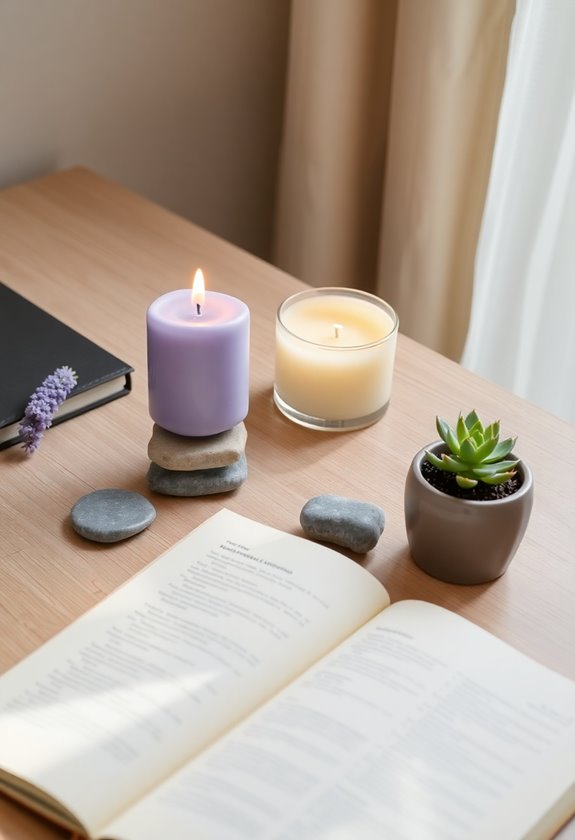
Once you've established your mindful study foundation, you'll want a set of quick techniques you can use anytime during your study sessions. These rapid-reset methods can help you maintain focus and clarity when your mind begins to wander or stress builds up.
- Take three deep belly breaths, counting to four on each inhale and six on each exhale
- Perform a quick body scan by tensing and relaxing each muscle group from your toes to your head
- Focus on five distinct sounds in your environment, noting their qualities and directions
- Place your hand on your textbook and notice its temperature, texture, and weight
- Pause to observe three specific thoughts passing through your mind without engaging them
These techniques shouldn't take more than 30-60 seconds each, making them perfect for brief mental resets between study topics.
Building Focus Through Breathing

Through controlled breathing exercises, you can greatly enhance your study focus and mental clarity. Here's how to practice mindful breathing while studying:
- Start by sitting upright with your feet flat on the ground, placing your hands comfortably on your lap or desk.
- Breathe in slowly through your nose for four counts, feeling your abdomen expand naturally as you draw in each breath.
- Hold the breath gently for two counts, maintaining awareness of the sensation in your chest and lungs.
- Release the breath through your mouth for six counts, letting tension flow out with each exhale.
- Continue this rhythmic breathing pattern for 3-5 minutes, and you'll notice your mind becoming clearer and more focused on your study materials.
- Return to this breathing technique whenever you feel your concentration starting to drift.
Mindful Study Environment Setup

Creating an intentional study space is essential for maintaining mindfulness while learning. You'll need to carefully design your environment to minimize distractions while maximizing your ability to stay present and focused.
Start by selecting a dedicated area that's well-lit and comfortable, but not so cozy that you'll be tempted to doze off. Clear your desk of unnecessary items, keeping only your study materials and perhaps a small plant or calming object within view. Position yourself where you won't face high-traffic areas or windows that might pull your attention away from your work. You'll want to maintain a room temperature between 68-72°F and guarantee proper ventilation, as these conditions have been shown to support ideal cognitive function and sustained concentration during study sessions.
Advanced Mindfulness Study Methods

Building on basic mindfulness practices, advanced study methods incorporate sophisticated techniques that deepen your learning experience. You'll want to integrate body-scan meditation between study sessions, systematically focusing your awareness from head to toe while noting physical sensations. Practice metacognitive monitoring by observing your thought patterns during challenging academic tasks, then adjust your approach based on these insights.
Begin incorporating visualization techniques where you'll mentally map complex concepts, creating detailed mental images that connect different aspects of your study material. When you're engaged in lengthy reading sessions, implement the STOP method (Stop, Take a breath, Observe, Proceed) every 20 minutes to maintain sharp focus and prevent mental fatigue. You can also use mindful note-taking, where you'll consciously engage with each piece of information while maintaining awareness of your learning process.
Frequently Asked Questions
How Does Mindfulness Affect Memory Retention and Information Processing During Study Sessions?
Mindfulness sharpens your attention and reduces mental clutter, allowing you to absorb information more effectively during study sessions. When you're fully present, you'll notice your brain processes and retains details more efficiently, as mindfulness activates regions associated with learning and memory. You'll experience enhanced cognitive flexibility and deeper comprehension because mindfulness reduces stress hormones that typically interfere with memory consolidation.
Can Mindfulness Exercises Help Reduce Test Anxiety and Exam-Related Stress?
Yes, mindfulness exercises can greatly reduce your test anxiety by helping you stay grounded in the present moment rather than worrying about future outcomes. You'll notice that regular mindfulness practice helps calm racing thoughts and lowers physical stress responses like rapid heartbeat and shallow breathing. When you incorporate mindfulness techniques before and during exams, you're better equipped to maintain focus and approach questions with a clearer, more balanced mindset.
What Role Does Music Play in Mindful Studying?
Music can be your mindful companion while studying, but you'll want to choose the right type. Instrumental or ambient tracks work best because they won't distract you with lyrics. When you select calming music at 60-80 beats per minute, you're creating an ideal environment for focus and relaxation. You'll find that background music helps mask distracting noises while maintaining a steady rhythm that supports your concentration and mental flow.
How Long Does It Take to See Results From Mindful Studying?
You'll likely notice initial improvements in focus and retention within 2-3 weeks of consistent mindful studying practice. Many students report experiencing better concentration and reduced anxiety after just 5-7 dedicated sessions, though lasting benefits typically emerge after 4-6 weeks of regular practice. Your progress depends on factors like consistency, environment, and individual learning style, but maintaining a steady routine will accelerate your results.
Should Mindfulness Exercises Be Done Before, During, or After Studying?
You'll get the most value by incorporating mindfulness at all three stages of your study session. Start with a 5-minute centering exercise before studying to clear your mind. During studying, take brief mindfulness breaks every 25-30 minutes to maintain focus and prevent mental fatigue. After studying, spend 3-5 minutes practicing mindfulness to help consolidate information and shift smoothly to your next activity.